Hardware design, for everyone

Democratising building hardware

Vibe Manufacturing

Describe what you want to build. Synqit draws the schematic, checks every part against its own datasheet, routes the board, and prices the bill of materials — so the distance between an idea and a working prototype is an afternoon, not a semester.

Company STATEMENT

AI made software abundant, but everything it multiplied is made of text. The problems still waiting are made of matter — a pump that works, a sensor that survives a monsoon, a device a village clinic can afford. Synqit exists so anyone who can think and type can build one: a farmer in a village in India, a high-schooler in a city, anyone with a real problem and no training in electronics. Knowledge shouldn't be the toll gate.

Websites online — measured GitHub repositories — measured Hardware designs — one measured point, 2025 Corridor where no series was ever published Projection range, 2026–2030
Sources — Internet Live Stats · GitHub Octoverse · PCB order volume, 2025. The 2026–2030 range is a projection, not a measurement.
What you get 01 — 05 Hover to read

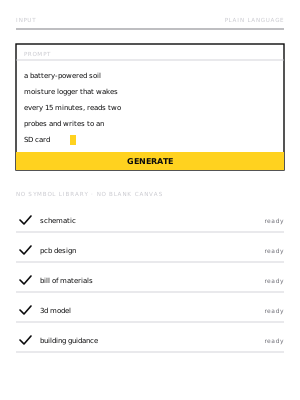
Just use plain language to prompt whatever you want to build

Describe it the way you would describe it to a colleague. No symbol libraries, no footprint hunting, no blank canvas. Then all five of these come back together, cross-checked against the manufacturers' own datasheets.

  • Schematics
  • PCB design
  • Bill of materials
  • 3D model
  • Building guidance
A prompt panel with a plain-language description of a soil moisture logger typed into it, a generate button, and the five deliverables listed as ready.
The whole input. One paragraph of plain English.

A schematic you can argue with

Read:

Real manufacturer part numbers, a power tree that closes, decoupling on every supply pin, and nets named the way a person would name them. It renders as an ordinary sheet on purpose — an engineer can read it, disagree with it, change it.

Routed, not just drawn

Read:

Placement, copper pour, trace widths sized to the current they carry, clearances checked against the fab rules you are actually ordering to. The design-rule check passes before you open a fab portal, not after they email you about it.

What it costs and what is in stock

Read:

Every part priced live against Mouser and DigiKey with stock shown. You find out that the part you designed around has an eleven-week lead time now, rather than at the point of ordering.

The thing itself, not just the board

Read:

A model of the product you described — the drone, the logger, the enclosure — with your board sitting inside it, checked for fit. You get the populated board on its own too. Both export as STEP, so they open in whatever you already use.

How to actually build it

Read:

Order, stencil, reflow profile, what goes in last, and what to measure first when you power it up. Written for the board you just designed, not a generic tutorial.

From the beta Run 0412

The check that
pays for itself

This is an unedited verification pass on a beta user's ultrasonic ranging board. Two of these would have cost a board spin. The second one is the kind of thing that is almost impossible to see by eye and completely obvious once named.

Nothing here is generated for the website. If a check is wrong, it is wrong in the product too, and we would like to hear about it.

How verification works

Verification · ranging-board-r2 6 checks · 4 pass · 1 warn · 1 fail
Pass Power tree closes — VBUS 5V → 3V3 LDO, 240 mA headroom at worst case U2 · p.7
Pass Decoupling present on all six IC power pins C1–C6
Pass SD card interface levels match MCU bank voltage J2 · p.11
Warn I²C pull-ups 10 kΩ — marginal for three devices at 400 kHz R7, R8
Fail U3 (HC-SR04) is powered from the 3V3 rail HC-SR04 · p.3
The datasheet specifies 5 V ±0.25 V at 15 mA. Below roughly 4.5 V the module does not reliably trigger — it goes quiet rather than failing loudly, so this reads as a firmware bug for a week.

Fix: take U3 from VBUS, and level-shift ECHO down to 3V3 before it reaches the MCU — a 2N7002 with 10 kΩ pull-ups, or one TXS0102.
Fail BIN2 appears on the motor driver symbol but not in the netlist U5 · net check
Channel B's second input is left floating. The motor will run in one direction and brake unpredictably in the other. Fix: connect BIN2 to the assigned MCU pin, or tie it low if channel B is genuinely single-direction.

Reproduced from a beta session, September 2025. Part numbers unchanged.

Where we stand Four short answers
01

What we do

Turn a described idea into a schematic, a verified netlist, a routed board, a 3D model and a priced bill of materials. You stay in charge of every decision; Synqit does the reading, the cross-checking and the arithmetic.

02

What we believe

That the ability to make a physical thing should not depend on having had access to a lab, a mentor, or four years of practice with a particular CAD package. The knowledge is all published. It is just unreasonably expensive to assemble.

03

Who it's for

The student with a working idea and no lab. The researcher who needs one instrument that nobody sells. The engineer who already knows how to do this and would simply rather not spend Thursday cross-referencing pin tables.

04

What Synqit is not

Not a replacement for knowing what you are building. Not a black box — every claim it makes is traceable to a page in a document you can open. It will not manufacture for you, and it will not tell you a design is safe. It tells you what it checked.

Film

What we are actually building toward

A world where the person who notices the problem is also the person who can build the thing that fixes it. Small, local, repairable, made by whoever needed it.

Begin

Build the thing
you keep describing

Start building Talk to us